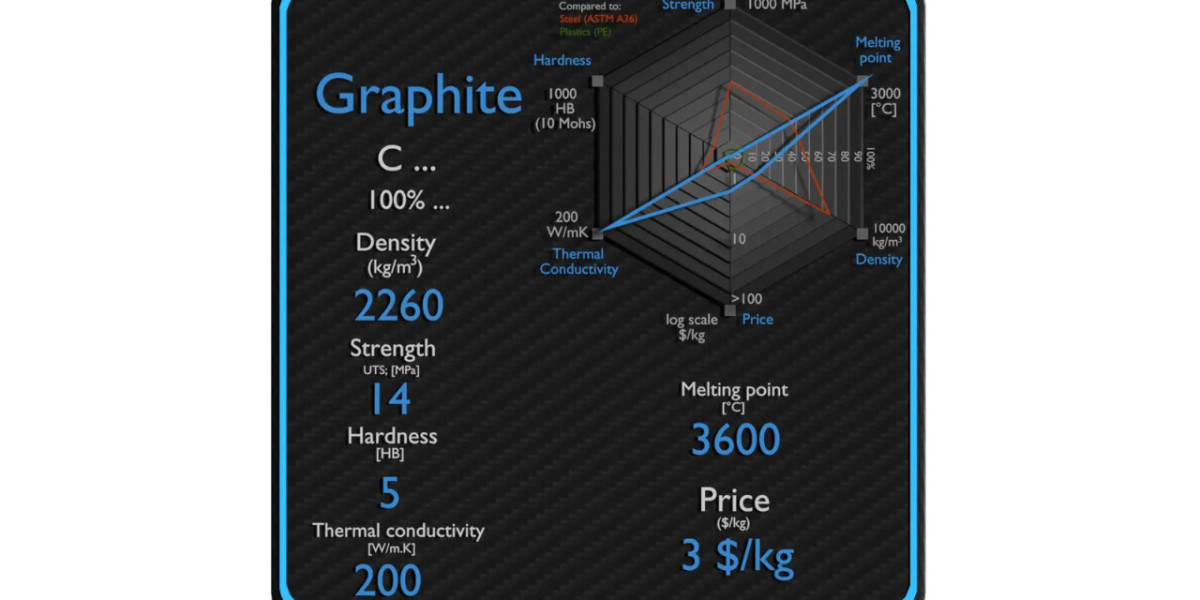

Graphite is a unique form of carbon widely used in industrial, scientific, and commercial applications due to its exceptional physical and chemical properties. One of the most important characteristics of graphite is its density, which plays a critical role in determining mechanical strength, thermal performance, electrical conductivity, and suitability for various applications. Understanding graphite density and accurate measurement methods is essential for engineers, researchers, and DIY enthusiasts who rely on graphite for batteries, electrodes, lubricants, and refractory materials.
Graphite density can vary depending on the type, purity, and manufacturing process. High-density graphite is preferred in batteries, electrodes, and high-performance industrial components, while lower-density or expanded graphite serves insulation, thermal management, and sealing applications. A thorough understanding of graphite density helps users make informed decisions and optimize performance in every application.
Key Properties of Graphite
Graphite has a layered hexagonal crystal structure in which carbon atoms form sheets. This arrangement gives graphite several unique properties:
Electrical Conductivity: Graphite conducts electricity effectively due to the free movement of electrons within its layers. This property makes it ideal for electrodes, battery anodes, and electronic applications.
Thermal Resistance: Graphite can withstand extremely high temperatures without decomposing, making it suitable for high-temperature industrial processes, crucibles, and refractory components.
Lubrication: The layered structure allows graphite to act as a dry lubricant, reducing friction in mechanical systems and industrial machinery.
Chemical Stability: Graphite is resistant to most chemicals and does not react easily with other substances, making it reliable in laboratories and industrial chemical processes.
Density: The density of graphite influences its mechanical strength, conductivity, and thermal performance. Natural graphite typically has a density of about 2.2 g/cm³, whereas synthetic graphite ranges from 1.5 to 2.3 g/cm³ depending on porosity and production methods. High-density graphite provides superior structural integrity and performance.
Types of Graphite and Their Density
Graphite comes in several forms, each with unique density characteristics and applications:
Natural Graphite: Extracted from mineral deposits, natural graphite is used in pencils, lubricants, and refractory applications. Its density varies due to impurities and crystal structure.
Synthetic Graphite: Produced from carbon-rich materials under controlled high-temperature conditions, synthetic graphite has consistent density and high purity. It is widely used in batteries, electrodes, and advanced industrial applications.
Expanded Graphite: Created by expanding natural graphite through thermal or chemical treatment, expanded graphite has lower density and high porosity. It is commonly used for insulation, gaskets, and sealing applications.
Graphene and Nano-Graphite: Advanced graphite forms with highly controlled density and layer arrangements. These are used in electronics, composites, and high-performance energy storage solutions.
Applications of Graphite Based on Density
Graphite density directly influences its suitability for various industrial, scientific, and DIY applications:
Industrial Components: High-density graphite is ideal for electrodes, molds, crucibles, and other equipment exposed to extreme temperatures. Consistent density ensures durability and reliable performance.
Battery Technology: Graphite is the primary anode material in lithium-ion batteries. The density of graphite affects conductivity, energy storage capacity, and overall battery efficiency. High-density synthetic graphite is preferred for high-performance batteries.
Lubricants and Coatings: Graphite serves as a dry lubricant in machinery, automotive systems, and industrial equipment. Particle uniformity and density directly affect lubrication performance.
Refractory Materials: Graphite combined with ceramics produces bricks and molds capable of withstanding high heat. Proper density ensures strength, thermal stability, and longevity.
Pencils and Writing Tools: Pencil lead quality depends on graphite density. Higher-density graphite produces darker, softer lines, while lower-density graphite results in harder, lighter lines.
Thermal Management: Expanded graphite, with lower density, is suitable for insulation, heat dissipation, and sealing applications due to its compressibility and thermal resistance.
Factors Affecting Graphite Density
Several factors determine graphite density and its performance:
Purity: Impurities in natural graphite reduce density and affect conductivity, thermal performance, and mechanical strength. Synthetic graphite offers more consistent density and higher purity.
Porosity: Higher porosity reduces density and impacts strength and conductivity. Expanded graphite intentionally uses high porosity for thermal insulation and compressibility.
Manufacturing Conditions: Temperature and pressure during synthesis affect graphite crystallinity, pore structure, and density. High-temperature synthetic graphite generally provides higher density and uniformity.
Additives and Binders: Graphite composites or materials mixed with binders may have modified density, affecting performance in specific applications.
How to Measure Graphite Density Accurately
Accurate graphite density measurement is crucial for quality control and performance optimization. Key methods include:
Archimedes’ Principle: This method measures the weight of graphite in air and its apparent weight in a liquid to calculate density. It is suitable for bulk materials and laboratory analysis.
Helium Pycnometry: Helium gas measures the true volume of graphite, including closed and open pores, allowing precise density calculation. Ideal for high-purity synthetic graphite.
X-ray and Neutron Techniques: Advanced methods such as X-ray diffraction (XRD) and neutron scattering evaluate graphite density and crystallinity for high-performance applications.
Tap Density and Bulk Density: Used for powdered graphite, tap density involves gently compacting material in a container. Bulk density is important for shipping, processing, and storage considerations.
Choosing Graphite Based on Density
Selecting the correct graphite density is essential for achieving optimal results:
High-Density Synthetic Graphite: Best for batteries, electrodes, and high-performance industrial components requiring conductivity and strength.
Moderate-Density Natural Graphite: Suitable for pencils, lubricants, and fillers.
Low-Density Expanded Graphite: Ideal for insulation, gaskets, and thermal management applications.
Understanding the relationship between graphite density and application performance ensures efficiency, safety, and durability.
Frequently Asked Questions
What is graphite density?
Graphite density is the mass per unit volume, typically measured in grams per cubic centimeter (g/cm³). It affects mechanical, electrical, and thermal performance.
Why is graphite density important?
Density influences conductivity, mechanical strength, thermal resistance, and overall performance in industrial, scientific, and DIY applications.
How can graphite density be measured accurately?
Density can be measured using Archimedes’ principle, helium pycnometry, X-ray techniques, or tap/bulk density methods depending on accuracy requirements.
Which type of graphite has the highest density?
Synthetic graphite produced under controlled high-temperature conditions usually has the highest and most consistent density.
Does graphite density impact battery performance?
Yes, higher-density graphite improves electrical conductivity, energy storage capacity, and battery efficiency.
What factors affect graphite density?
Purity, porosity, manufacturing process, and additives or binders influence graphite density.
Conclusion
Graphite density is a vital property that determines the performance, reliability, and suitability of graphite for a wide range of applications. Understanding graphite types, properties, measurement methods, and applications enables engineers, researchers, and DIY enthusiasts to make informed choices. High-density synthetic graphite is preferred for battery anodes and industrial electrodes, while expanded graphite serves insulation and thermal management purposes. Accurate density measurement and proper selection ensure efficiency, consistency, and durability in all applications, making graphite an indispensable material in modern industry, technology, and research.