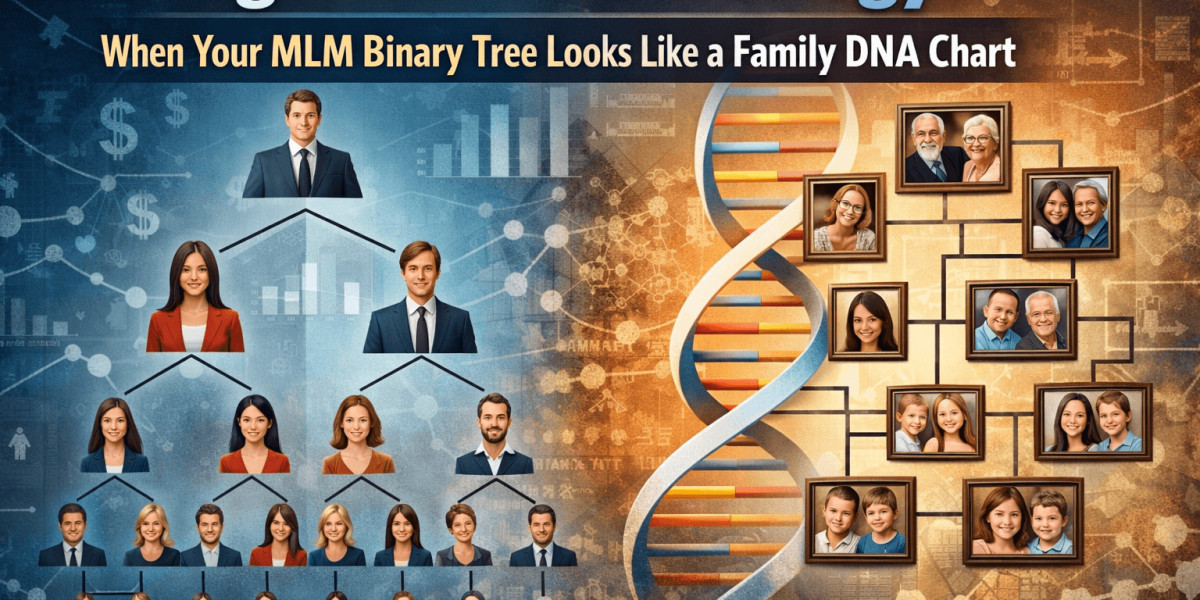

Have you ever stared at a family tree during a genealogy project and thought, "This looks oddly familiar"? If you're involved in multi-level marketing, that sensation might not be coincidental. The binary structure used in MLM compensation plans shares a striking resemblance to genealogical charts—both mapping relationships, inheritance, and downward progression through generations.
But here's where it gets interesting: while family trees trace bloodlines, MLM binary trees trace something equally powerful—business relationships, commission flows, and network expansion. Understanding this parallel isn't just an amusing observation. It reveals why binary structures work so effectively in network marketing and how they create predictable, trackable growth patterns similar to genetic inheritance.
This comparison goes deeper than surface-level similarities. Both systems deal with growth exponentials, relationship mapping, and the challenge of visualizing complex networks without losing clarity.
The Structural DNA of Binary Trees
Binary trees in MLM follow a deceptively simple rule: each member can sponsor exactly two frontline distributors. This creates a left leg and a right leg beneath every participant, mirroring how each person in a family tree has two parents above them.
The elegance lies in the constraint. Unlike other MLM structures that allow unlimited width, binary plans force vertical depth. This means your network grows downward rather than outward, creating long chains of relationships that extend through multiple levels.
Think about how genealogists map family connections. They don't cluster all cousins on one level or randomly place relatives. There's a systematic approach: parents above, children below, siblings side by side. Binary MLM structures follow this same disciplined architecture.
The mathematical beauty emerges quickly. Starting with one person at the top, level two has two positions, level three has four, level four has eight. By the tenth level, you're looking at 512 positions. By level twenty, over one million. This exponential pattern mirrors population growth in family lineages, where each generation can theoretically double the previous one.
Spillover: The Genetic Lottery of Network Marketing
In genealogy, you inherit traits from ancestors you never chose. In binary MLM, you experience something similar through spillover—when your upline places new recruits under you, filling positions in your tree without your direct effort.
This creates an interesting dynamic. Just as you might inherit your grandmother's eye color or your grandfather's height, you can inherit downline members from your sponsor's recruitment efforts. The placement isn't random though. Understanding how Binary MLM software works reveals the algorithms that determine where new members land in the structure.
Spillover can feel like winning a genealogical lottery. You wake up to find new team members in your organization, generating volume and helping you qualify for commissions. But there's a catch—just as genetic inheritance doesn't guarantee success in life, spillover doesn't guarantee active, productive team members.
The passive nature of spillover creates both opportunity and complication. Some distributors build entire organizations primarily through their upline's efforts. Others find themselves with inactive branches that look impressive on paper but contribute little to actual sales volume.
Balancing Acts: The Left-Right Symmetry Challenge
Family trees aim for completeness—documenting both maternal and paternal lines equally. Binary trees create a similar pressure toward balance, but for financial rather than historical reasons.
Most binary compensation plans pay commissions based on your weaker leg. If your left side generates $10,000 in volume and your right side generates $3,000, you typically get paid on the $3,000. This creates intense focus on balancing both sides of your tree.
The balancing requirement mirrors how genealogists strive to research both family lines equally. Skip your father's side, and you're missing half the story. Neglect your right leg in MLM, and you're leaving money on the table.
This forced balance prevents the natural human tendency to favor one direction. Without it, most distributors would stack everyone on one side, creating a massively unbalanced structure. The compensation plan's design nudges behavior toward symmetry.
The challenge intensifies as your organization grows. Managing balance across two legs with dozens or hundreds of levels requires constant attention. Some distributors develop elaborate tracking systems, color-coding their genealogical charts of business relationships to visualize where attention is needed.
Generation Depth: Tracking Your Business Lineage
Genealogists talk about generations—grandparents, great-grandparents, great-great-grandparents. Binary MLM creates business generations in the exact same way. Your personally sponsored members are your first generation. Their recruits become your second generation, and so on.
Unlike unilevel plans that pay you differently based on which generation someone appears in, binary plans care more about total volume and leg balance. But the generational concept still matters for understanding your network's depth and health.
A shallow tree with only three or four generations might look neat, but it's not leveraging the true power of binary structure. The real multiplication happens when you have active distributors ten, fifteen, or twenty generations deep. Each level amplifies the effect of the levels above it.
This is where the genealogical parallel becomes instructive. Family historians know that going back seven generations means potentially tracking over a hundred ancestors. Similarly, reaching seven deep binary generations means managing relationships across 128 positions in just that level alone.
The depth dimension adds complexity. You can't personally know everyone in your tenth generation any more than you can personally remember your great-great-great-great-great-great-great-grandparents. This is where systems, communication tools, and automated tracking become essential.
Software as Your Digital Genealogy Archive
Professional genealogists abandoned paper charts decades ago. The complexity of tracking hundreds or thousands of family connections demanded digital solutions. MLM binary structures face the same requirement.
Modern custom MLM software for your business model functions as your digital genealogy archive, maintaining perfect records of who sponsored whom, when they joined, their position in the tree, and their volume contributions. Without this technological backbone, managing a binary organization would be nearly impossible.
The software doesn't just store data—it visualizes relationships. The best platforms render your binary tree in intuitive, interactive formats. You can collapse branches, expand sections, highlight specific legs, and trace paths from top to bottom just like genealogy software lets you navigate family trees.
Real-time updates matter enormously. When a new member joins your organization, the software instantly places them in the structure, recalculates volumes, updates balances, and adjusts commission projections. This immediacy would be unthinkable with manual tracking.
Advanced platforms include predictive modeling. Just as genetic genealogy can estimate ethnic percentages or potential health markers, MLM software can project growth trajectories, identify weak branches needing attention, and forecast commission earnings based on current trends.
Inheritance Patterns: How Value Flows Through the Tree
In biological genealogy, inheritance flows downward—from parents to children. In binary MLM, value flows in multiple directions simultaneously, creating a more complex inheritance pattern.
Downward inheritance happens through training and culture. The way you build your business influences how your direct recruits build theirs, which affects their recruits, propagating through generations. This cultural transmission works exactly like family values passing from grandparents through parents to children.
Upward inheritance appears in commission structures. Your downline's efforts generate volume that flows up through the legs, creating earnings for you and your upline. This reverse inheritance doesn't exist in biological family trees, making the MLM version more dynamic.
Lateral inheritance emerges through spillover. Your sponsor's other recruits—your business "siblings"—can indirectly benefit you if they're placed in your organization. You didn't recruit them, but you inherit their impact.
The complexity of these inheritance patterns explains why successful binary MLM participants become obsessed with understanding their tree structure. Unlike genealogy, which is fixed at birth, your business genealogy constantly evolves based on actions taken throughout the network.
The Missing Branches: Dealing with Attrition
Every family tree has gaps—lost records, unknown ancestors, broken lineages. Binary MLM trees develop their own gaps through attrition. People quit, become inactive, or simply stop producing volume.
These dead branches create the same frustration genealogists feel when they hit a documentary dead end. You might have a beautiful structure on paper, but inactive members contribute nothing to your actual earnings. They occupy positions without generating movement.
The permanence of placement makes this particularly challenging. Unlike rearranging puzzle pieces, you can't remove inactive members and compress your tree. Their position is fixed in the genealogical record of your organization. New activity must build around or beneath these gaps.
Smart distributors develop strategies for reactivating dormant branches. Just as genealogists sometimes discover new documents that fill in missing ancestors, you might find ways to re-engage inactive members or support their downline to rebuild activity in those sections.
Prevention works better than resurrection. Building a culture of sustained activity from the start creates healthier long-term tree structure. This means focusing recruitment on people genuinely committed to the business, not just filling positions to achieve balance.
Pattern Recognition: Reading Your Binary Family History
Experienced genealogists develop pattern recognition skills. They spot naming conventions, migration patterns, and family traits that help fill in gaps and make predictions. Successful binary MLM distributors develop similar skills.
You start recognizing patterns in how your tree grows. Certain leaders consistently build deep organizations. Some branches expand rapidly but lack staying power. Particular placement strategies yield better long-term results than others.
These patterns become predictive. When you see certain characteristics in a new recruit or notice specific growth indicators in a developing leg, you can anticipate how that branch will likely evolve. This isn't mysticism—it's pattern recognition based on your organization's historical data.
The genealogical mindset helps here. Just as family historians study multiple generations to understand inheritance patterns, MLM leaders should analyze their tree across many levels. Surface-level observation of your frontline tells you almost nothing about organizational health.
Seasonal patterns emerge too. Some periods drive explosive growth while others see consolidation. Understanding these cycles helps you time recruitment pushes and training initiatives for maximum impact, just as genealogists learn which archives are accessible during which months.
Binary Ethics: The Responsibility of Your Downline Legacy
Genealogy carries ethical dimensions. How you treat family information, whether you share discoveries, and how you represent your heritage matters. Binary MLM structures create analogous ethical considerations.
Your position at the top of a binary leg means others depend on your leadership, training, and support. You're not just building your business—you're affecting the success potential of everyone beneath you in the structure. This responsibility shouldn't be taken lightly.
The temptation exists to prioritize your strong leg while neglecting the weak one, or to focus only on personally sponsored members while ignoring deeper generations. This is like a genealogist only documenting the famous ancestors while ignoring the working-class branches.
Transparent communication becomes crucial. Your downline deserves to understand how the structure works, where they fit, and what realistic expectations look like. Overpromising spillover or misrepresenting the balance requirements damages trust throughout the organization.
The long-term health of your binary tree depends on maintaining integrity across all relationships. Short-term manipulation might boost one quarter's commissions, but it creates genealogical scars that weaken the structure for years.
Conclusion
The parallels between genealogical charts and MLM binary trees run deeper than visual similarity. Both systems map relationships, track inheritance, deal with exponential growth, and require sophisticated tools to manage complexity. Understanding your binary organization through a genealogical lens provides valuable insights into structure, growth patterns, and long-term sustainability.
The genealogist's patient, detail-oriented approach serves network marketers well. Success isn't about explosive surface growth—it's about building a sustainable, balanced tree that produces value across multiple generations. When you treat your binary organization with the same care a family historian applies to documenting lineage, you create something built to last.
Your MLM binary tree is your business legacy. Like any family tree, it reflects the decisions, relationships, and patterns established by those who came before while creating the foundation for those who will follow. Tend it carefully, balance it consistently, and you'll build something worth inheriting.