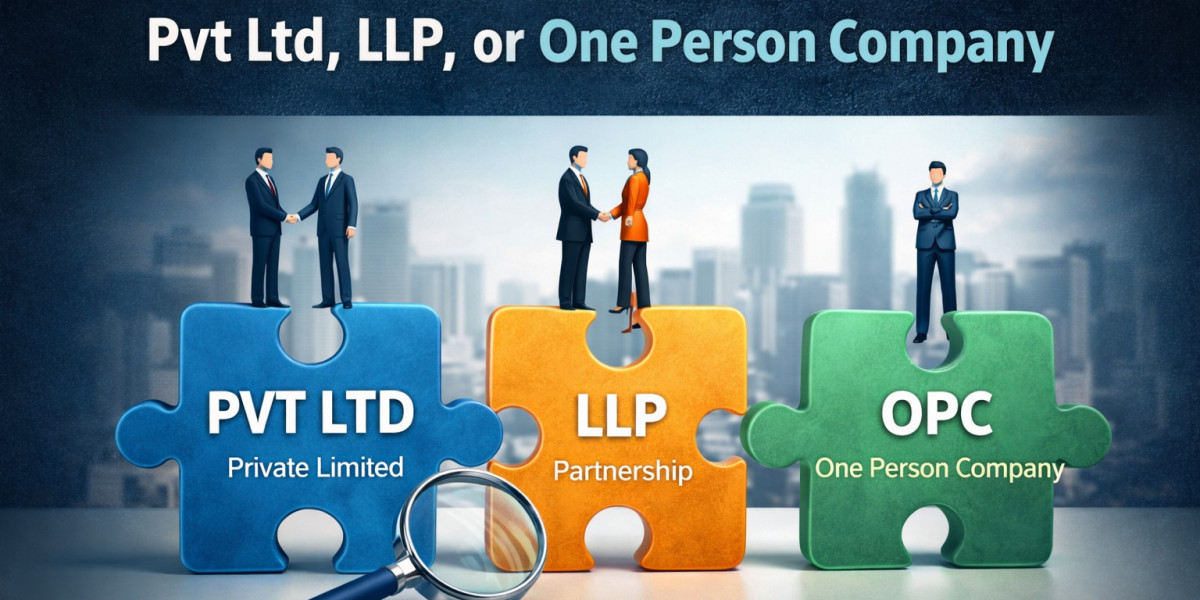

Starting a business in India begins with one crucial decision—choosing the right business structure. Your choice will impact taxation, compliance requirements, funding ability, liability, ownership control, and long-term growth. Among the most popular options for entrepreneurs and startups in India are Private Limited Company (Pvt Ltd), Limited Liability Partnership (LLP), and One Person Company (OPC).
This article explains each structure in detail and helps you decide which one is best suited for your business goals.
Why Choosing the Right Business Structure Matters
Selecting an appropriate business structure is not just a legal formality. It affects:
Personal liability of owners
Tax rates and compliance burden
Ease of raising funds
Credibility with investors and clients
Scalability and exit options
A wrong choice can lead to unnecessary compliance costs, higher taxes, or difficulty in expansion later.
Overview of Business Structures in India

Let’s understand each structure in detail.
1. Private Limited Company (Pvt Ltd)
What is a Private Limited Company?
A Private Limited Company is a separate legal entity registered under the Companies Act, 2013. It is one of the most preferred business structures for startups, technology companies, and businesses planning rapid growth.
Key Features of Pvt Ltd Company
Separate legal identity
Limited liability for shareholders
Can raise funds from investors
Easy transfer of ownership through shares
High credibility in the market
Advantages of Pvt Ltd Company
1. Limited Liability Protection
Shareholders are not personally liable for company debts beyond their shareholding.
2. Easy Fundraising
Pvt Ltd companies can raise equity from angel investors, venture capitalists, and private equity firms.
3. High Business Credibility
Banks, investors, and large clients prefer dealing with Private Limited Companies.
4. Scalability
Ideal for businesses planning national or global expansion.
Disadvantages of Pvt Ltd Company
Higher compliance requirements
Annual filings, audits, and board meetings mandatory
Slightly higher incorporation and maintenance cost
Best Suited For
Startups seeking investment
Businesses planning rapid growth
Companies with long-term expansion goals
2. Limited Liability Partnership (LLP)
What is an LLP?
A Limited Liability Partnership combines the benefits of a partnership firm and a company. It is governed by the LLP Act, 2008 and is popular among professionals and small businesses.
Key Features of LLP
Separate legal entity
Limited liability of partners
Flexible management structure
Fewer compliance requirements
Advantages of LLP
1. Lower Compliance Burden
Compared to Pvt Ltd companies, LLPs have fewer filings and relaxed compliance rules.
2. Limited Liability
Partners are not personally liable for business losses or misconduct of other partners.
3. Cost-Effective
Lower incorporation and operational costs make LLP ideal for small businesses.
4. No Minimum Capital Requirement
Partners can start with any capital amount.
Disadvantages of LLP
Difficult to raise equity funding
Less attractive to investors
Transfer of ownership is complex
Best Suited For
Professional firms (CA, CS, lawyers, consultants)
Small and medium enterprises
Businesses not seeking external investment
3. One Person Company (OPC)
What is an OPC?
A One Person Company allows a single individual to start a company with limited liability. Introduced under the Companies Act, 2013, OPC is ideal for solo entrepreneurs.