
Introduction
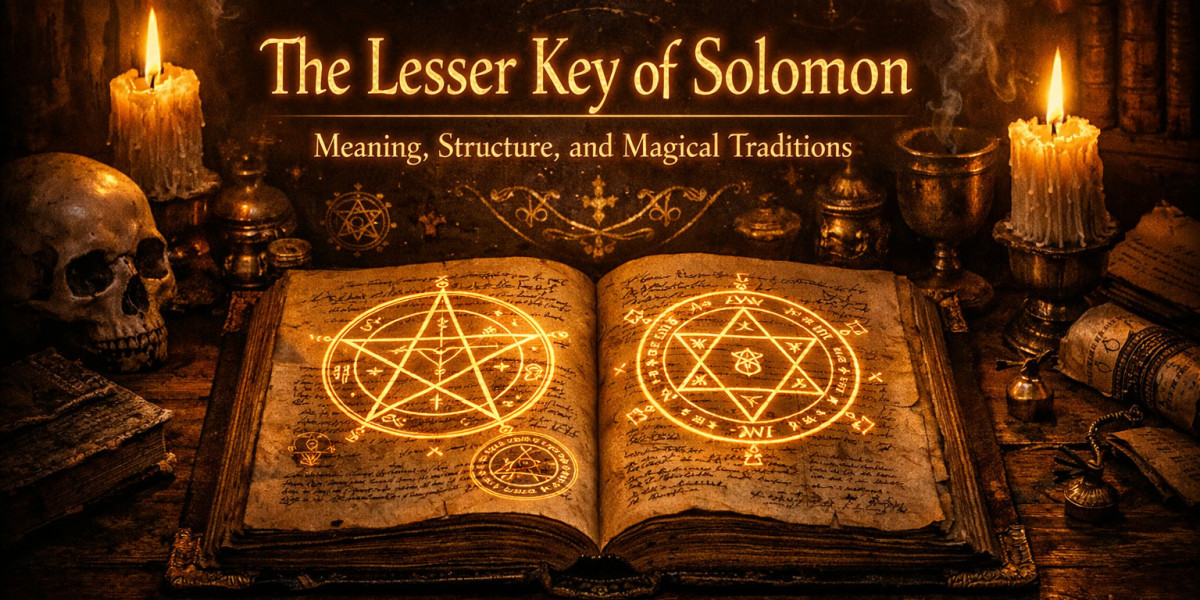
The Lesser Key of Solomon is one of the most famous and influential grimoires in Western esoteric history. Known for its detailed description of spirits, rituals, symbols, and ceremonial magic, this ancient text has fascinated scholars, occult researchers, historians, and collectors for centuries.
This guide explores the meaning, structure, and magical traditions of the grimoire in a scholarly and symbolic manner, helping modern readers understand its historical depth, spiritual symbolism, and long-lasting influence.
Meaning and Origin of The Lesser Key of Solomon
The name Lesser Key of Solomon reflects a magical tradition attributed to the legendary King Solomon, who was believed to possess divine wisdom and supernatural authority over spirits. Although the text itself was compiled in the 17th century, its roots trace back to older medieval and Renaissance magical manuscripts.
The word Key symbolizes hidden knowledge, spiritual authority, and access to unseen realms. Rather than being a simple magical book, the grimoire represents a system of ceremonial magic combining religion, mysticism, astrology, and symbolism.
Purpose and Significance of the Grimoire
The primary purpose of the text was to document ceremonial rituals used to communicate with spiritual entities—both angelic and demonic—within a structured magical framework.
Its significance lies in:
Preserving ancient ceremonial traditions
Influencing Western occult philosophy
Providing symbolic teachings on discipline, knowledge, and spiritual authority
Serving as a foundation for later magical and esoteric studies
Today, it is studied not only for occult interest but also for historical, symbolic, and psychological interpretation.
Structure of The Lesser Key of Solomon
The grimoire is divided into five distinct books, each focusing on different aspects of ceremonial magic and spiritual knowledge.
Ars Goetia
This is the most famous section of the grimoire. It describes 72 spirits and their symbolic hierarchy, attributes, and seals.
Key elements include:
Names and ranks of spirits
Magical seals (sigils) representing each spirit
Ritual structure for invocation
Symbolic representation of human desires, fears, and inner forces
Many modern scholars interpret Ars Goetia psychologically, viewing the spirits as symbolic manifestations rather than literal beings.
Ars Theurgia-Goetia
This section focuses on aerial spirits connected with the four cardinal directions.
It describes:
Spirit hierarchies linked to space and direction
Cosmic order and spiritual structure
Balance between celestial and earthly forces
Theurgia-Goetia blends mystical cosmology with ceremonial symbolism.
Ars Paulina
Ars Paulina is centered on angelic magic and celestial influences.
Major themes include:
Zodiac and planetary connections
Angelic hierarchies
Spiritual timing and cosmic alignment
Astrology as a sacred science
This section reflects Renaissance beliefs about the connection between heaven, astrology, and spiritual knowledge.
Ars Almadel
Ars Almadel introduces a mystical tool called the Almadel, used in rituals for angelic communication.
It emphasizes:
Spiritual vision and higher wisdom
Symbolic ritual tools
Purification and preparation
Divine guidance through meditation and prayer
Unlike other sections, it focuses more on enlightenment than control.
Ars Notoria
This final section differs from the rest. Instead of spirit invocation, it focuses on knowledge, memory, and divine wisdom.
It contains:
Sacred prayers and orations
Techniques for intellectual and spiritual growth
Symbolic pursuit of enlightenment
Historically, scholars viewed Ars Notoria as a method for gaining wisdom rather than magical power.
Magical Traditions and Practices
The Lesser Key of Solomon reflects the structured discipline of ceremonial magic, which emphasizes preparation, symbolism, and spiritual focus.
Core elements include:
Ritual circles representing protection and unity
Sacred symbols and sigils as spiritual language
Invocation and prayer as tools of focus
Discipline, purity, and mental clarity
Modern interpretation often sees these rituals as symbolic practices for psychological transformation and self-mastery.
Symbolism and Hidden Meanings
Much of the grimoire operates on symbolic rather than literal levels.
Seals and Sigils
These represent spiritual forces, archetypes, and psychological energies rather than physical entities.
Spiritual vs Literal Interpretation
Many researchers interpret the text metaphorically—as a system of inner transformation rather than external magic.
Esoteric Symbolism
The grimoire reflects themes such as:
Control over desire and fear
Search for hidden knowledge
Balance between light and shadow
Spiritual authority through wisdom
Historical Influence and Legacy
The Lesser Key of Solomon significantly shaped Western esoteric tradition.
Its influence can be seen in:
Renaissance occult philosophy
Later magical texts and grimoires
Modern ceremonial magic systems
Academic studies of mysticism and symbolism
It remains one of the most studied and collected grimoires in the world.
Modern Interpretation and Relevance
Today, the grimoire is examined from multiple perspectives:
Academic View
Historians study it as a cultural and symbolic manuscript of Renaissance mysticism.
Psychological Interpretation
Some scholars view its spirits and rituals as representations of the human subconscious and archetypal forces.
Esoteric Study
Occult researchers analyze its ritual symbolism, cosmology, and spiritual philosophy.
Its continued popularity shows its relevance as a historical, symbolic, and philosophical work rather than merely a magical manual.
Common Misconceptions
Myth: It is only about demonology
Reality: The grimoire includes angelic, intellectual, and spiritual teachings.
Myth: It promotes dark magic
Reality: Many parts emphasize wisdom, discipline, and spiritual purification.
Myth: It is purely fictional
Reality: It is a historical text reflecting real Renaissance esoteric traditions.
Conclusion
The Lesser Key of Solomon remains one of the most influential grimoires in Western esoteric history. Its deep symbolism, structured knowledge, and spiritual themes continue to attract scholars, researchers, and collectors worldwide.
Understanding its meaning, structure, and magical traditions reveals not just a magical manuscript, but a complex system of symbolism, philosophy, and spiritual discipline that has endured for centuries.
FAQs (SEO Optimized)
1. What is The Lesser Key of Solomon about?
It is a 17th-century grimoire describing ceremonial magic, spiritual symbolism, and structured knowledge of spirits and angels.
2. How many spirits are listed in Ars Goetia?
Ars Goetia describes 72 symbolic spirits and their hierarchy.
3. Is The Lesser Key of Solomon historical or mythological?
It is a historical grimoire influenced by mythology, religion, and Renaissance esoteric traditions.
4. What are magical seals used for?
They symbolize spiritual forces, archetypes, and ritual focus rather than literal entities.
5. Why is this grimoire important?
It shaped Western occult philosophy and remains significant in symbolic, historical, and academic studies.










Rare Biblio 7 sa
https://rarebiblio.com/product/9789333319973/the-lesser-key-of-solomon-goetia